Northern Cardinal
The Eastern Bluebird is easily one of my favorite birds. Unlike the migrant birds the Bluebird stays put the entire year through cold and heat.
I like the Bluebird so much that I make nesting boxes so that my property will be more attractive to them. I even give a few boxes to my friends so that they can also enjoy the Bluebird. Aside from its gorgeous color the Bluebird also has a very melodious voice. I enjoy sitting on my porch swing and listening to their serenade. My Bluebirds seem to prefer that I keep the lawn closely cropped. I think a short crop helps them easily spot tasty meals of grasshoppers and crickets. The male Bluebird at left was patiently waiting his turn to share a tasty morsel with his offspring. The female was sitting on a powerline letting me know her displeasure of my close proximity to the nesting box. Some people open their Bluebird boxes periodically so that they can monitor the nesting cycle from egg to fledgling. I generally open mine only for cleaning before the start of a new nesting season. Enjoy the fun, put up a Bluebird box.
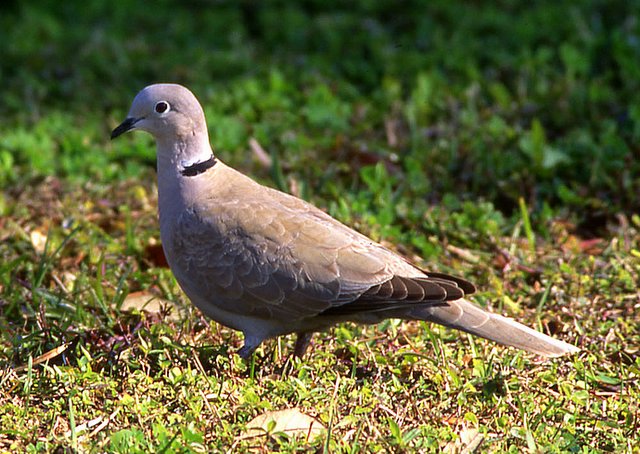
The image at right is of a Eurasian Collared-Dove and was taken at a small park in Titusville, Florida.
This Dove is not a native of North America but was introduced from Europe. Like its human predecessors it is now rapidly colonizing North America. It originally took hold in South Florida. It is now seen up into Tennesse and as far west as Texas with its range continuing to increase. It is slightly larger than the native Mourning Dove and somewhat lighter in color. Some people theorize that it is using the rail system to expand its range as small colonies seem to turn up near railroad tracks. It would seem a bit odd that a bird would prefer rail travel over air travel. I much prefer the Eurasian Collared-Dove over other introduced species such as the obnoxious English Sparrow and European Starling.

The exploration of the Louisiana Purchase Territory by Lewis & Clark is legendary history. They discovered many species of previously unknown plants and animals. One of the new species of birds that was encountered is seen at left, and is known as the Clark's Nutcracker. I was on Trail Ridge Drive which is the main road through Rocky Mountain National Park in Colorado. I was aware that the Nutcracker frequented a pullover area known as Rainbow Curve. The Nutcrackers and Stellar Jays at this site thrive on being fed by visitors. One tasty morsel they seem to delight in is Ritz Crackers. The Nutcrackers especially will often take an entire Ritz from your hand. At Rainbow curve you are just over two miles above sea level. Even in mid summer a warm jacket is usually a highly desired item at this elevation. Just beyond Rainbow Curve you ascend into the Tundra area of the Park at elvations over 14,000 feet. There are some walking trails at this elevation. Be mindful however that with even the slightest exertion you may become winded due to the thin air. The awesome views available will register permanent images in your memory bank.
Terns are in the Gull family but are usually smaller and more slender and have straighter bills.
I guess you could say they are more aerodynamically shaped and this reveals itself in their flight patterns. There are some 18 species of Terns including the Skimmers and Noddies. You will not see all 18 in one area, so if you want to see them all it will require much travel. This Royal Tern was sunning himself on the Gulf Shore of St. Josephs Peninsula State Park near Port St. Joe, Florida. The Royal Tern is one of our two largest Terns and also sports a Crest. A few other Tern names are Elegant, Sandwich, Sooty, Caspian, and Aleutian. Most Terns will search for small fish often diving headfirst from a hovering position into the water. Skimmers prefer flying low over calm water, slicing their lower mandibles through the surface to snag a small fish.
I love Sunsets, and for that matter Sunrises as well. I am awake for more sunsets though. A Beautiful Sunset is always a pleasure to behold. A Beautiful Sunset with an isolated person, immovable object or other living creature is just outright inspirational. I have captured Sunsets with people, birds, boats, trees, and other objects included. I think my favorite though are the Sunsets with birds. I went looking for this Sunset. This Great Blue Heron is one of many that frequent the waters below Chickamauga Dam in Chattanooga Tennessee. My challenge was to get them together in one frame. It was enjoyable moving slowly along the shore, stumbling over rocks, and attempting to frame the heron and sun for my perfect Sunset image. I like the results and hope you do too.